
Declaration of interest: I worked in polling 2015-2024, including at YouGov between 2015 and 2020.
Last week, YouGov retracted a poll suggesting church attendance had risen sharply among younger people in England and Wales. The poll, published as part of a Bible Society report called Quiet Revival, claimed that the share of young people going to church had jumped from 4 per cent in 2018 to 16 per cent in 2024.
It was later withdrawn because of what YouGov described as “a number of respondents who we can now identify as fraudulent”. I should say at the outset that I think YouGov deserves real credit for how it responded to questions about their research. They investigated what went wrong, admitted the problem, and were transparent about the findings. And the problem they are grappling with here is very far from being just a YouGov issue, but an industry-wide one, and one with wide ranging consequences.
To understand what likely happened here, it helps to remember that the vast majority of market research and polling in the UK is conducted online. This means lots of people across the country sign up to panels using their email addresses and then get regularly invited to fill in surveys online in exchange for small rewards (the occasional payment into a bank account, an Amazon voucher, or something similar).
As you might expect, the people who join these panels are not, by themselves, representative of the country. One of the jobs of modern researchers is to turn that unrepresentative pool into something that looks like the wider population. In practice, that means inviting the right mix of people from the panel to each individual survey, so that you end up with the correct balance of men and women, old and young, graduates and non-graduates, and so on.
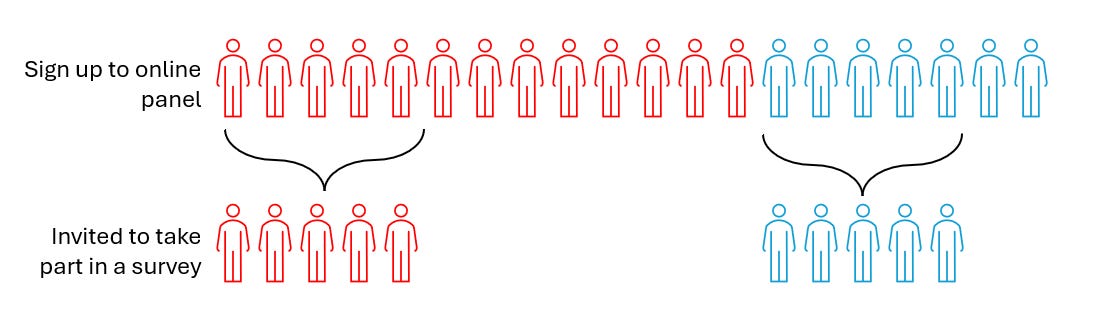
The picture above is a very basic example. Imagine you had a panel of 20 people, 13 of whom were red and 7 of whom were blue. But in the real world we know there are equal numbers of red and blue people, so for a survey you would invite 5 of your 13 red panellists and 5 of your 7 blue panellists to take part. It is like that, but with thousands of people and many more variables.
Crucially, this also means that if you belong to a group that is less likely to sign up to an online panel, like the blue people in the example above, you get invited to more surveys. In this case, a blue person would have a 71 per cent chance of being invited to a survey, compared with a 38 per cent chance for a red person.
For a long time, pollsters got pretty good at this. Agencies like YouGov helped pioneer the model internationally and became highly skilled at making it work. It allowed the sector to scale enormously, bring down costs for businesses, deliver work at pace, and do so with a pretty high degree of accuracy.
But YouGov began polling when the internet was a very different place. More people were asking Jeeves than Googling, Charlie had not yet been born, let alone bitten anyone’s finger, and if you tried to make a phone call while someone else was online you were greeted by that dreadful dial-up screech.
And since then, a new problem has been growing fast: fake accounts set up to harvest survey incentives. We called them “bots”, but in practice they are often just large numbers of fake or semi-automated accounts, controlled by one person, all trying to extract those payments at scale.
There have always been people on the internet trying to game any system with a cash reward attached to it. And like everyone else online, research agencies have always had tools to try to catch and block people who are playing the system. But AI has made it much easier to do this at scale, and much harder to spot who is real and who is not.
So what has this got to do with young men?
If you are setting up these fake accounts, you want to be invited to the most surveys, so that you can make the most money. And if you want to be invited to the most surveys, you set those accounts up claiming to belong to a demographic that is underrepresented on panels.
And the most underrepresented group is almost always young men.
These fake accounts are then more likely to produce junk data, which often means more random answers. For example, if a survey asks a yes or no question, a fake respondent may be just as likely to click one as the other. If you ask a question like “Is the Earth flat?”, where only a tiny minority of real respondents would say yes, every extra bot nudges the yes figure upwards. The demographic with the most bots will therefore be the demographic most likely to appear to believe that the Earth is flat.
And so young men have become the Florida Man of British polling: the group that keeps appearing in headlines because they are supposedly more likely to believe something bizarre, do something alarming, or spend their weekends participating in some newly invented moral panic. If you believed every headline, you would think the average 24-year-old man was attending church in the morning, investing in crypto by lunch, and overthrowing liberal democracy by teatime.
This is not to say that we should dismiss all survey research on younger people, or young men. I am reasonably confident, for example, that young men and young women are diverging politically. I am also confident there is something real in polling suggesting that younger men are more likely than the generation before them to think equal opportunities for women have gone too far.
Sometimes that will reflect something real. But quite often, I suspect, we are making sweeping claims about the attitudes and behaviour of young people, especially young men, on the basis of ropey data.
In my final few years in market research, I became increasingly frustrated by how little urgency there was in preparing for this problem. It was obvious that AI was going to make it much harder to tell who was and was not a real person, and the industry was not moving fast enough to respond. I was fortunate enough to work for two agencies, YouGov and Opinium, that did take this seriously, even though there was not much incentive for them to do so.
If you are a client receiving polling results, it is very hard to judge the quality of the underlying sample. You care about the tables, the charts, and the headlines, but it is tricky to work out what is happening under the bonnet. Or put yourself in the shoes of someone commissioning research. How do you justify paying more for a company that says it has better anti-fraud protections when you cannot easily see what those protections are worth, or properly measure the difference they make? There are very few public metrics that make it easy to compare agencies on this.
That is the core of the problem. The market does not reward quality control nearly enough, because quality control is hard for buyers to see. So if you are a polling company trying to maximise revenue, what is more attractive: hiring another salesperson, or spending more on anti-bot systems?
So while I began with a YouGov poll being retracted, I do not think YouGov is the villain of this story. If anything, it is widely seen as one of the better firms when it comes to trying to deal with these threats. It has said that the issue here was caused by human error, where key quality control technologies were not activated. Many other companies would not even have bothered with such technologies in the first place.
And this is painful for me, because I strongly believe in the importance of good market research. Most people might just encounter this work through newspaper headlines they do not take too seriously, or through whatever the Prime Minister’s approval ratings happen to be doing that week. But it is incredibly important for policymaking, for effective public services, and for growth in our economy.
How do we know whether a new product will sell, a campaign will change behaviour, or a new bus route will actually be used? How do we know whether a training scheme or public service will genuinely improve outcomes, rather than just soak up money?
It’s difficult to answer these questions without good market research.
Or, if you ever have some spare time, it is worth reading about my former boss Joe Twyman’s time polling in Baghdad after the fall of Saddam, and the heroic work the team did there for, among others, the UN and the newly formed Iraqi Electoral Commission. Polling is not always about finding out whether people prefer Coke to Pepsi. Sometimes it is about helping rebuild a country.
For my own small part, while I am proud of the work I did for the Labour Party, I will always be proudest of the work I did for Boris Johnson. It was not especially difficult or sophisticated, but each morning during the pandemic I ran a set of results for the Cabinet Office, looking at how the public were responding to lockdown measures, which messages were cutting through, and which behaviours might be increasing the spread of the virus. It is not something I could ever prove, obviously, but I have little doubt that work helped inform decisions that saved lives.
It is therefore vital to solve the challenges set out above, and I do not think they are unsolvable. Like so much in modern life, it has become an arms race between people using technology to cheat and people using technology to stop them. But that requires the industry to move together to improve standards, create stronger incentives for better practice, and become much more transparent about data quality.
Success would mean our world-leading market research sector continues to thrive. It might spare us a few dramatic think pieces about what young men are supposedly up to.
Here's the BBC More or Less investigating the same claim, back in July 2025: https://www.bbc.co.uk/programmes/m002f8wq
Very well put Chris.